
Workplace safety in manufacturing and logistics is changing faster than most plant managers realize. Here’s what the data says about where it’s headed and what’s worth paying attention to now.
U.S. employers reported 2.5 million nonfatal workplace injuries and illnesses in 2024, the lowest number since BLS began tracking the series in 2003, according to the Bureau of Labor Statistics. The rate fell to 2.3 cases per 100 full-time equivalent workers, down from 2.4 in 2023. The trend is improving. The underlying causes of the most costly injuries, however, have barely moved.
Overexertion remains the most expensive injury cause, year after year
Liberty Mutual’s 2025 Workplace Safety Index reports that overexertion involving outside sources––pushing, pulling, lifting, carrying––accounts for $13.7 billion in U.S. workplace injury costs annually. It has held the number one spot for over two decades. Falls on the same level come in second at $10.5 billion. Together, these two categories represent more than 40 percent of total serious workplace injury losses.
Total workplace injury costs reached $181.4 billion in 2024, according to the National Safety Council, with the cost per medically consulted injury averaging $48,000. For musculoskeletal disorders specifically, the category where manual material handling sits, direct costs per case range from $15,000 to $85,000. Its indirect costs often double or triple that figure when lost productivity, replacement labor, and claims administration are included.
The implication for plant managers is straightforward: the headline injury statistics are improving, but the cost structure of the most common injuries hasn’t changed. Every manual pushing and pulling task that can be mechanized reduces exposure to the category costing the most.
Technology is entering the safety function
AI-driven safety tools, wearables, and connected worker platforms are moving from pilot programs into standard practice across manufacturing and logistics. Organizations using AI safety platforms report up to 30 percent fewer workplace incidents, and the global AI workplace safety market is projected to grow at an 18.2 percent compound annual growth rate through 2030, reaching $6.8 billion.
What this looks like in practice: computer vision systems that flag PPE non-compliance or identify near-miss situations in real time; motion sensors that detect ergonomic risk postures before an injury occurs; and predictive platforms that identify which jobs or workers are at highest cumulative injury risk based on task data.
For manual material handling specifically, these tools are increasingly used to quantify ergonomic exposure, tracking how many times per day workers perform high-force pushing and pulling tasks and flagging facilities where that frequency exceeds safe thresholds.
Ergonomics investment is increasing
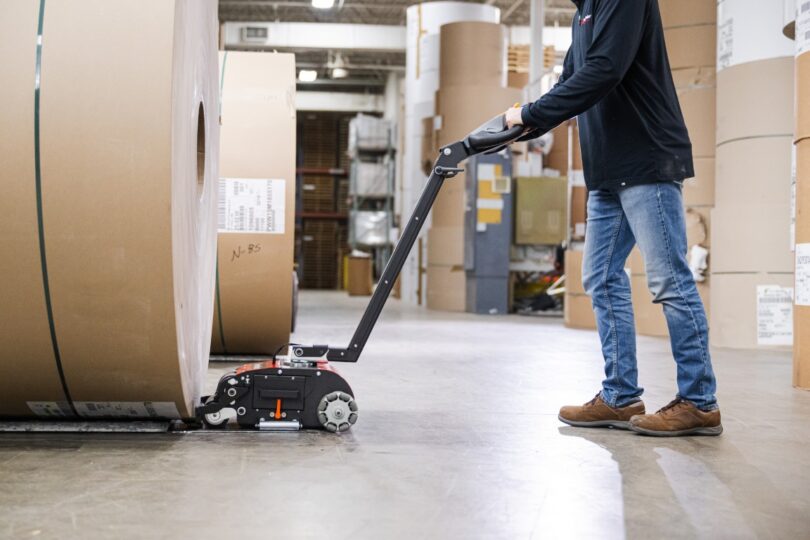
Powerpusher Positioning Paper Rolls Warehouse
Warehousing, assembly lines, and logistics environments are seeing increased investment in ergonomics programs, job rotation, and tool or workstation redesign. The trend reflects both rising workers’ comp costs and a tightening labor market: facilities that injure workers spend more to replace them.
OSHA’s ergonomics approach is enforcement through the General Duty Clause, which requires employers to address recognized hazards, including musculoskeletal risks from manual handling. State-level plans in states like California and Washington apply stricter ergonomics requirements. Facilities operating in multiple jurisdictions are increasingly standardizing to the most stringent applicable standard rather than managing compliance state by state.
Safety is becoming part of the employer brand
In a competitive labor market, safety records matter for recruitment. Workers in manufacturing and logistics actively consider safety when choosing employers. Facilities with strong safety cultures, where injury rates are low and equipment matches the demands of the work, find it easier to hire and retain experienced workers.
The shift is from compliance-driven safety (what do we have to do to avoid a citation) to culture-driven safety (what do we do to make sure people go home in the same condition they arrived). Those aren’t the same programs, and the difference shows up in both injury rates and turnover numbers.
What this means for manual material handling
The common thread across all of these trends is that the facilities investing in safety infrastructure are moving away from manual movement of heavy loads wherever the task can be mechanized. Electric pushers and tuggers sit squarely in that shift: they address the most costly injury category (overexertion), reduce ergonomic exposure, and are easy to incorporate into existing workflows without major facility changes.
The facilities still relying on manual team efforts to move vehicles, carts, and equipment are running against every direction the data points.
See how PowerPusher fits into your safety program. → Request a demo
FAQ
Q: Are workplace injuries actually declining, or are fewer being reported?
Both factors are likely at play. BLS data shows a genuine decline in reported injuries, but underreporting is a known issue in occupational health research. The more reliable signal is cost data: the Liberty Mutual Safety Index, which tracks workers’ comp costs, still shows overexertion as the number one expense category with no meaningful decline in its share of total costs.
Q: What’s the best first step for a facility starting to address ergonomic risk?
Identify the tasks where workers most frequently push, pull, or lift loads that require significant force or multiple people. Those are your highest-exposure tasks. Mechanizing those tasks first produces the greatest risk reduction per dollar spent.
Q: Do AI safety tools replace the need for physical ergonomic improvements?
No. They identify risk more precisely and faster, but they don’t remove the risk. A sensor that detects a high-force pushing task doesn’t make the push safer. The physical solution, mechanical assist equipment, is still where the injury prevention happens.
Q: Is OSHA moving toward mandatory ergonomics standards?
OSHA has not reintroduced a general ergonomics standard since the 2001 repeal. Enforcement happens under the General Duty Clause, which requires addressing recognized hazards. Some state-plan states have adopted their own ergonomics requirements. Facilities should track their own state’s regulatory status.
Sources
- BLS Employer-Reported Workplace Injuries and Illnesses 2024 — https://www.bls.gov/news.release/osh.nr0.htm
- Liberty Mutual 2025 Workplace Safety Index — https://www.libertymutualgroup.com/about-lm/news/articles/us-companies-spend-50.87b-year-top-ten-causes-serious-workplace-injuries-according-2025-liberty-mutual-workplace-safety-index
- National Safety Council, Work Injury Costs 2024 — https://injuryfacts.nsc.org/work/costs/work-injury-costs/
- StartUs Insights, Top 10 Workplace Safety Trends 2026 — https://www.startus-insights.com/innovators-guide/workplace-safety-trends/
- OSHA Ergonomics Overview — https://www.osha.gov/ergonomics